Predicting the impacts of climate change on the distribution, upslope range shifts, and asymmetric habitat loss of Valeriana jatamansi Jones ex Roxb. in the Indian Himalayas
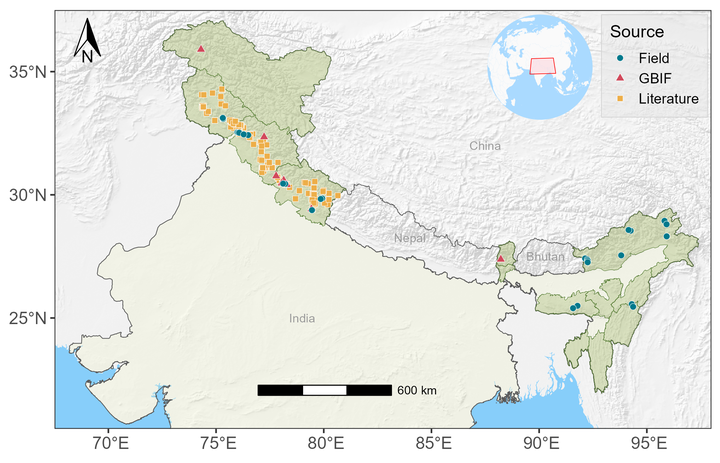 Image credit: Authors
Abstract
Climate-induced shifts in environmental conditions are expected to modify geographic distributions of species across multiple spatial and temporal scales. Given the ecological sensitivity of the Himalayas and the increasing vulnerability of species distributions to changing climatic conditions, we employed a MaxEnt model with intra-model ensembles to predict the habitat suitability of Valeriana jatamansi, a valepotriates rich herbaceous plant widely recognized for its medicinal and industrial uses, under current and projected climate change pathways. Its natural habitats are rapidly declining due to urbanization, climate change impacts, and unsustainable extraction. Based on 189 cleaned occurrence records, the model revealed climatic extremities and seasonality as the most influential variables influencing its distribution. The maximum temperature of the warmest month (bio5) had the most dominant effect; habitats experiencing bio5 above ~25 °C were not suitable for its occurrence. Under the ssp585 climate scenario projected for the year 2100, the species is expected to experience consistent habitat loss and an upward shift in its elevational range, highlighting its high vulnerability to climate change. Among the Himalayan states in India, Jammu & Kashmir in the western Himalayas is projected to gain the maximum area of suitable habitat. On the contrary, the eastern Himalayan populations are more vulnerable and may lose suitable habitats more rapidly than other Himalayan regions. They should be prioritized for in situ and ex situ conservation and reintroduction. This study provides a predictive framework to support climate adaptation and conservation strategies in the Indian Himalayas.
Abhishek Kumar
Project Associate II
My research interests include plant ecology, plant distribution and open science.