Elevational Patterns of Plant Species Richness: Insights from Western Himalayas
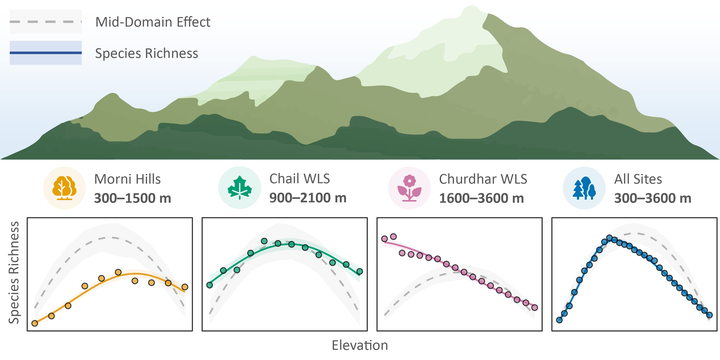 Image credit: Authors
Abstract
Understanding the patterns and drivers of species distribution has remained a central theme for biogeographical, conservation, and ecological research. This study aims to investigate the elevational patterns of plant species richness and compare the observed species richness with the predictions of the mid-domain effect (MDE) null model. By combining information from field observations and the published literature, we compiled a comprehensive database of the elevational distribution of plant species for three protected areas in the Western Himalayas. We used generalised linear model (GLM) and null model simulations to explore the elevational patterns of plant species richness. Our study revealed simple linear to complex non-linear patterns depending on the location and range of the elevational gradient. While non-linear unimodal patterns were common, a linear decreasing pattern was also observed. The observed species richness showed consistent deviations from the predictions of the mid-domain effect null model, suggesting that factors beyond the range constraints shape species richness patterns. These observations indicate that richness patterns are not solely generated by random processes, rather climatic gradients, ecological interactions, and topographic heterogeneity can shape these patterns. Understanding these factors can aid in predicting and managing the impacts of ongoing environmental changes on Himalayan biodiversity.

Abhishek Kumar
Senior Research Fellow
My research interests include plant ecology, restoration ecology and soil ecology.